
AI Is A Gateway To The Welfare State
October 6, 2026 |
Keith Giles


White Christians, primarily white Christian nationalists, represent the true core and base of the Republican Party. Ryan Burge, a leading expert in religious statistics, can substantiate this claim. (If you haven’t subscribed to his Substack by now, I suggest you do so)
In his December 29 post, Burge analyzed the 2024 election results by religious affiliation. The results are clear. The largest coalition within the Republican Party is white Christians.
Here are a few data nuggets from Burge:
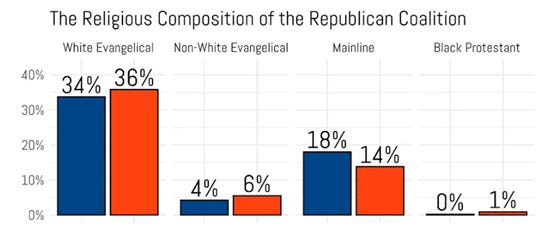
This chart shows the percentage of support comparing 2008 (blue) to 2024 (orange). It might be surprising that McCain’s support came from 34% evangelicals, but remember the evangelical Palin effect that year.
Compare the Republican religious affiliation with the Democrats. The results are as clear as day.
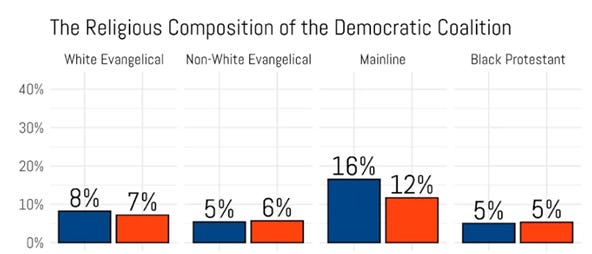
Looking at these results, you would wonder why the Democrats win any elections at all. There is an answer…they are called the Nones. This group is larger than white Christians and decidedly votes Democratic.
Here is how Burge described the effect of the Nones:
“So, how do Democrats not get blown out in every election? It’s the nones. That’s the answer. There are a lot of nones, and they lean heavily towards the Democrats. I just wrote about this, but I want to make this point clear – atheists and agnostics were 16% of the Obama coalition. Now, they are about a quarter of the Democratic Party. If you throw the nothing in particulars in there, the nones make up 45% of all Democratic votes cast. That’s up 10 points since 2008.”
Burge calls this the “God gap.” He summarized his analysis this way:
The GOP vote is 80% Christian and 17% non-religious.
The Democratic vote is 48% Christian and 45% non-religious.
That’s the God Gap.
It is not hyperbole to say that the Republican Party is a religious party, and the Democratic Party is the party of the non-religious. Christian nationalism is the energy from which the power of the Republican Party comes; it drives the culture wars and brings out voters. This group of voters is pivotal and influential, as we have seen in the past four election cycles.
Ironically, they are a minority of Americans. But they are highly motivated to vote, especially for Donald Trump. They were the bulwark of Trump’s victories in 2016 and 2024.
This group has proven remarkably immune to scandal, policy failure, moral contradiction, and even attacks on democracy itself. The persistence of this loyalty has led many observers to ask a blunt question:
Is there anything Trump could do to lose them?
The uncomfortable answer, supported by data and history, is minimal, in other words, “not much.” This is not because Christian nationalists are uniquely gullible or immoral. It is because their support for Trump is not conditional in the traditional sense.
Their support for Trump is identity-based, civilizational, and theological, rooted in a worldview that treats politics as a zero-sum struggle for dominance and existence, rather than a forum for democratic consensus and compromise. Christian nationalists are not playing by the same set of rules as Constitutionally grounded citizens and conventional politicians would assume.
It is vital for analysts and observers to avoid conflating Christian nationalism with Christianity itself. They are not the same. Survey research consistently shows that belief in Christian nationalism predicts Trump support far more strongly than church attendance, prayer, or theological orthodoxy.
The Public Religion Research Institute (PRRI), which has tracked Christian nationalism for years, defines it through agreement with statements such as:
The United States was founded as a White Christian Nation with a divine purpose.
The Founders were all Christians.
The Founders used the Bible as the basis for our founding documents and meant for it to be the backbone of our laws.
The Founders meant for the separation of church and state to protect the CHURCH from the STATE, not the other way around.
Across multiple surveys, PRRI finds that self-identified Christian nationalist adherents (10 percent) and Christian nationalist sympathizers (20 percent) support Trump at rates exceeding 70 percent, even when controlling for race, education, and religious practice.
By contrast, regular church attendance alone is a weak predictor of loyalty to Trump. In short, Christian nationalism is not about personal piety, church attendance, or even orthodox religious viewpoints. It is about collective identity and political power. It has little to do with religion or morality.
Trump’s personal behavior violates nearly every moral norm traditionally preached by American churches: serial adultery, public cruelty, habitual lying, vulgarity, and open contempt for humility or repentance. Yet none of this has meaningfully dented Christian nationalist support.
That is not hypocrisy…it is coherence.
Within Christian nationalist thinking, Trump is not judged as a moral exemplar. He is judged as a protector and champion. As one evangelical leader put it bluntly in 2016, “I’m not electing a pastor in chief.” Translated, this means Christian nationalism is not a moral construct; it is a political one.
Jerry Falwell Jr., then president of Liberty University, went further. Asked whether there was anything Trump could do to lose his support, Falwell replied flatly: “No.” He later explained that Trump was a “fighter” chosen by God, for a moment of existential threat.
This language matters. Christian nationalism frames American politics as a spiritual war in which secularism, pluralism, feminism, LGBTQ rights, immigration, and multicultural democracy are existential dangers to a Christian social order. In war, one does not demand moral purity from generals. One demands victory.
Trump’s norm-breaking, aggression, and refusal to apologize are not flaws in this framework; they are assets.
Political scientists and social psychologists emphasize that identity-based politics is uniquely resistant to facts or evidence. When political loyalty is tied to who someone is, rather than to their policies or preferences, evidence rarely persuades. Instead, it radicalizes.
Christian nationalism operates through a siege narrative: Christians, as they see themselves, are portrayed as a persecuted majority. Cultural and demographic change are framed as deliberate displacement. Institutions such as the media, universities, and courts are seen as hostile occupiers.
Never compromise with your existential opponents.
Within this narrative, attacks on Trump are experienced as attacks on the group itself; therefore, they come to his defense even when overwhelming evidence convicts him during an impeachment. Indictments become proof of persecution, not wrongdoing. Court losses become evidence of corruption, not judgment. Even electoral defeat is reinterpreted as theft, hence, January 6, 2021.
This helps explain why Trump’s election denial resonates so powerfully with this base. Democracy is acceptable only insofar as it preserves what they believe to be a God-ordained hierarchy. God ordains Trump, but not Biden. When democracy threatens that hierarchy, it becomes illegitimate.
Empirically, Trump scandals have had near-zero lasting effect on Christian nationalist support.
The Access Hollywood tape produced no sustained drop. Two impeachments did not weaken loyalty. January 6 increased distrust of institutions—not Trump. Criminal indictments have been framed as martyrdom.
PRRI and Pew surveys repeatedly show that Christian nationalists are the least likely group to believe Trump did anything wrong, even when presented with documented evidence.
They are also the most likely to believe that “true American patriots may have to resort to violence” to save the country—a belief that correlates strongly with Christian nationalist identity.
This is not volatility. It is entrenchment. And, from their point of view…completely logical.
The reason “nothing” seems to disqualify Trump is structural, not personal. Christian nationalism subordinates ethics to outcomes. The moral question is not “Is Trump good?” but “Is Trump useful to God’s plan for America?” This logic allows virtually unlimited rationalization of moral indiscretion.
Cruelty is reframed as toughness. Corruption is reframed as persecution. Sexual indiscretion is reframed as a momentary lapse, and authoritarianism is reframed as order, and violence is reframed as righteous defense.
Even policies that harm many Christian nationalist voters economically are tolerated if they reinforce hierarchy, identity, and cultural dominance. Status matters more than material well-being. Give the billionaires tax breaks? Yes…because Trump identifies with us.
At the individual level, maybe. At the group level, barely.
Some Christian nationalists might defect if Trump explicitly and openly repudiated their vision, for instance, if he openly affirmed secular pluralism, LGBTQ equality, or religious neutrality of the state. But even here, history suggests many would reinterpret or deny such statements rather than abandon him. They live in the right-wing media bubble, which reinterprets all of Trump’s actions as sanctified.
More importantly, Trump has no incentive to cross that line. Christian nationalism supplies him with unconditional loyalty, justification for minority rule, and moral cover for authoritarian behavior. Why would he cross the line of those who give him unyielding support?
He gives them something just as valuable in return: validation. Don’t underestimate the power of this. Christian nationalists have been looking for validation for decades. They were happy to have their voice heard, but now, Trump validates their most essential identity and has given them a seat at the table of power. He tells them they are the “real Americans,” that their loss of dominance is illegitimate, and that any means necessary to restore it are justified.
The claim that there is “almost nothing” Trump can do to lose Christian nationalists is not hyperbole. It is a recognition of how identity, theology, and power interact. And the power of self-aggrandizement and the need to be right are mighty indeed.
Many Christian nationalist supporters would rather grovel in the pit of self-deception, rather than admit to the unthinkable horror of error and the debasement of being wrong. Saving face is more psychologically satisfying than admitting the truth.
Additionally, Christian nationalism is not a voting bloc that weighs costs and benefits. It is a movement that sees itself in an existential struggle. Trump is not a candidate to be evaluated. He is a vessel; flawed, impure, but chosen…but chosen to save them and their version of America.
As long as Trump affirms their grievance and dominance, attacks their perceived enemies, and undermines democratic constraints on their power, their loyalty will hold. That reality has profound implications—not just for elections, but for the future of American democracy itself.
We live no longer in a reality-based political environment. It is a fairy tale, an Alice-in-Wonderland political wilderness. Truth does not matter, but conspiracy-laced theological interpretations mean everything. Let the pedophile rapist continue to have power as long as he affirms our agenda.
You might not have been paying attention, but NO, the Epstein files will not impale Christian nationalist support for Donald Trump. This isn’t about morality or justice. It is about identity and justification for grievance and status. It reflects the same narcissistic pathology of Trump, with the exact selfish needs of Christian nationalists.
Christian nationalism is not primarily a moral movement. It is a power movement that uses religious language and images, but espouses no real spiritual inclination. Trump is not loved because he embodies Christian virtue; he is lauded and protected because he delivers outcomes.
The Epstein files will not matter to them. Here is why…
Christian nationalism creates a transactional theology: God uses imperfect vessels to enact divine will. Trump’s sins are reframed as irrelevant, unimportant—or even necessary. The logic is simple and durable: “God used King David. God used the Persian King Cyrus. God can use Trump.”
Once faith is operationalized and made transactional in this way, moral disqualification disappears as a concept. It doesn’t matter what Trump has done; he is God’s chosen instrument and vessel. Moral clarity and reality dissolve into irrelevance.
In addition, Christian nationalist ideology increasingly relies on existential threat narratives: America is under siege, Christianity is being erased, and liberals, secularists, immigrants, and LGBTQ people are agents of civilizational collapse.
In this worldview, standard ethical rules no longer apply. Trump isn’t judged as a man; he’s regarded as a weapon in a holy war. Morality be damned. Winning is the only objective.
Epstein revelations threaten Trump as a man, but Christian nationalism needs him as a tool and a symbol. Don’t count on a collapse of support for him, at least among Christian nationalists, no matter what the Epstein files reveal.
People don’t leave authoritarian movements because they’re convinced they’re wrong. They leave when the movement demands too much, delivers too little, and offers no joy beyond domination.
Katherine Stewart, author and expert on Christian nationalism, says this about their unconditional support of Donald Trump:
“Conservative Christians [believe they] are the most persecuted groups in society. And therefore, you need a strongman to come in and crush your perceived enemies. You don’t want a nice guy to be in control; you want a mean guy who’s gonna crack heads, as long as those heads belong to your perceived enemies. It shows how the party as a whole has, frankly, abandoned democracy. They’ve abandoned the idea that they might need to share power or compromise. And they’ve really embraced a full authoritarian mindset, which says that they alone are the godly rulers, and they’re going to seize power by any means necessary.”


