
AI Is A Gateway To The Welfare State
October 6, 2026 |
Keith Giles


If you recognize any of these names, then you are at least familiar with a vague group of Charismatic Evangelical Christians that are loosely affiliated with the “New Apostolic Reformation.”
Che Ahn
Jim Garlow
Bill Hamon
Cindy Jacobs
Chuck Pierce
Dutch Sheets
Lance Wallnau
Paula-White Cain
This is a group of self-styled, self-appointed “prophets” of the NAR, and they claim to have direct divine communications from God. In other words, they claim to be prophets. And they have direct access to the President.
More precisely, they can be described as Christian Supremacists (as opposed to just Christian Nationalists), because they accept the teachings of the Seven Mountains Mandate.
The Seven Mountain Mandate, they believe, commands that Christians not only have a seat at the table of power, but take control of the seven institutions of society: government, family, religion, education, media, arts and entertainment, and business. They believe that God has commanded that only Christians are suited to take control and govern these dimensions of society.
Their claim to be prophets is what I want to focus on. Because if they are in any way suggesting that they are following a Biblical model of a “prophet,” then they are either misleading people or are ignorant of what the Bible says. (Hint: it is likely both)
In Biblical terms, prophecy is fundamentally a moral message or truth communicated from God to humans through a designated spokesperson, known as a prophet.The nature of this communication is seldom about future events, although that is the common understanding of the word.
Most of the prophetic literature in the Bible is not about the future; rather, it calls people back to God, applies divine truth to current behavior, especially that of political leaders, and warns of the consequences of straying from God’s covenant.
In short, prophets were spokespeople who stood outside of power and spoke truth to power. They were the conscience of the nation, not the enablers of its corruption.
This is the opposite of the self-proclaimed NAR prophets who are more likely to be cozy with power, enable Donald Trump’s worst inclinations, and tell him what he wants to hear.
They are fakes and frauds when it comes to the Biblical pattern of the “prophetic voice.”
The Bible has a great deal to say about political power. Not much is good.
It does not tell us that kings are inherently evil, nor does it tell believers to withdraw from public life. But it does tell us something that should make every Christian who seeks political influence uncomfortable:
According to the Bible, Kings, Presidents, and any national leader are accountable to God. And the purpose of the prophetic voice is to remind them of that truth.
The Old Testament has example after example of God sending prophets to remind them. None of them seek power for themselves, but they do make political leaders very uncomfortable.
Nathan confronts King David.
Elijah confronts King Ahab.
Amos confronts a society that has become prosperous by exploiting the poor.
Isaiah condemns rulers who make unjust laws.
Jeremiah warns kings who have abandoned righteousness.
Micaiah refuses to tell King Ahab what he wants to hear.
These prophets perform one of the most important functions in biblical political theology: they place moral limits on political power. It is the Bible’s equivalent of a check and balance on power.
The prophet does not exist to make the king feel righteous. The prophet exists to tell the king when he is wrong. That raises a deeply uncomfortable question for American Christianity today:
Where are the prophets today? The real ones?’
Consider these examples from the Old Testament:
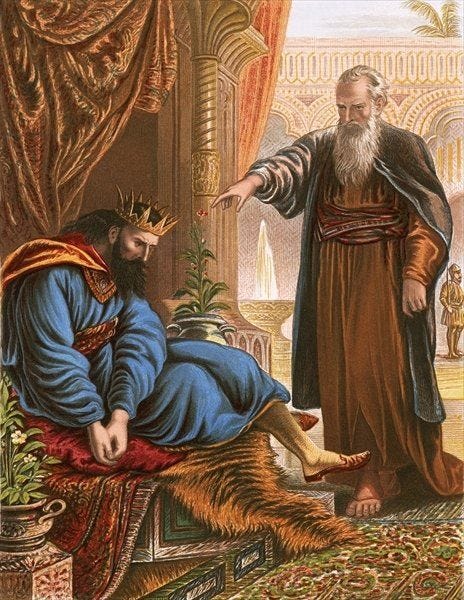
Perhaps the most famous confrontation between a prophet and a king occurs when the prophet Nathan confronts David.
David has abused the power of his office to take Bathsheba, the wife of Uriah. When David cannot conceal the affair, he arranges for Uriah to be placed in a battle position where he will be killed.
David is the king. He is also God’s anointed. But Nathan does not allow David’s sacred status to become an excuse for his behavior. Nathan tells David a story about a wealthy man who takes a poor man’s beloved lamb. David becomes furious at the injustice.
Then Nathan turns the story back upon him and says to David:
“You are the man!”
—2 Samuel 12:7
That may be one of the most important sentences in the Bible about political power. Nathan does not say, “David is God’s chosen king, so we must be careful about criticizing him.”
He does not say, “David has accomplished too much to undermine his presidency.” He does not say, “David’s enemies will exploit this scandal.”
He says:
You are the man.
You did this. You are responsible. You are accountable. God’s anointed leader is still accountable to God.
That is the prophetic tradition. That is what prophets do.
The confrontation between Elijah and King Ahab is equally instructive.
Ahab wants Naboth’s vineyard. Naboth refuses to sell it because it is his ancestral inheritance. Jezebel, Ahab’s wife, then arranges for a false accusation and the execution of Naboth, allowing Ahab to take possession of the property.
The king has gotten what he wanted. But Elijah arrives with a message from God.
“Have you killed and also taken possession?”
—1 Kings 21:19
The prophet’s question is the indictment. It is not about whether Ahab is politically successful. It is not about whether he has advanced Israel’s interests. It is not about whether Naboth was politically important.
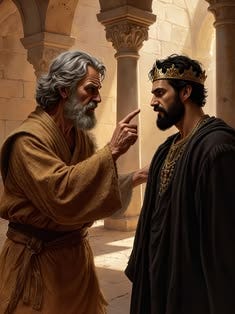
The issue is justice. Have you killed and taken possession?
The king’s power does not make his actions righteous. There is no such thing as Presidential immunity in the Bible. That principle runs throughout Scripture.
The prophet Amos takes the argument even further.
Israel has religious institutions, worship, festivals, and sacrifices. But in Amos’ day, society had become deeply unjust. The rich exploit the poor while maintaining the outward forms of religious devotion.
God’s response, through Amos, is devastating:
“I hate, I despise your festivals.”
—Amos 5:21
And then comes the line that should haunt anyone who claims to govern in the name of Christianity:
“But let justice roll down like waters, and righteousness like an ever-flowing stream.”
—Amos 5:24
The message is unmistakable.
Religious performance and outward demonstrations of piety do not compensate for injustice. Standing in front of a church holding a Bible doesn’t make the ruler righteous.
A government does not become Christian because its politicians invoke God. A political movement does not become righteous because it displays crosses. A president does not become morally legitimate because evangelical leaders pray with him.
The biblical test is what Amos says it is:
Where is the justice?
Isaiah makes the political implications explicit and leaves no room for doubt:
“Woe to those who make unjust laws, to those who issue oppressive decrees, to deprive the poor of their rights and withhold justice from the oppressed of my people.”
—Isaiah 10:1–2
This is not vague spirituality. It is a direct indictment of immoral government actions. The prophet is telling rulers that God cares about the laws they make and the people those laws affect.
The poor matter. The oppressed matter. Justice matters, and the government is morally accountable.
It is the prophet’s responsibility to say so.
Then there is Micaiah.
King Ahab is preparing for war and consults his fake prophets. They tell him exactly what he wants to hear: victory is assured.
But Micaiah refuses to participate in the charade. In fact, King Ahab openly hated Micaiah and complained that he never prophesied anything good for him.
When pressured to agree with the royal prophets, Micaiah responds:
“As surely as the LORD lives, I can tell him only what the LORD tells me.”
—1 Kings 22:14
The prophet tells the king that the attack will fail. Micaiah understands something that contemporary Christian political movements desperately need to recover:
The prophet’s loyalty is to God, not to the king and not to Donald Trump.
His obligation is not to preserve his access, protect the king’s reputation, or maintain political influence. His obligation is to tell the truth.
And because the truth is unwelcome, Micaiah is imprisoned. That is the cost of prophetic integrity.
The current Christian Supremacists who surround the Trump administration are nothing more than courtiers.
A courtier serves in the halls of power, but is there to enable, attend to, and flatter the ruler. They are not there to tell the truth. And here is the enormous difference between the prophetic voice and a courtier:
The prophet asks:
Is the king behaving justly?
The NAR courtier asks:
How can I defend the king?
The prophet asks:
Are the vulnerable being protected?
The NAR courtier asks:
How can I explain this policy to the faithful even though it is harmful?
The prophet confronts corruption.
The NAR courtierrationalizes it.
The prophet risks losing access to power.
The NAR courtier fears losing access to power and will do anything to keep it.
The self-appointed NAR prophets who surround Trump are nothing but courtiers. They are not prophets in any Biblical sense. Which of them has ever challenged or confronted Donald Trump’s egregiously immoral policies?
Who has said to Trump, your ICE raids are excessive and punish innocent people?
Who has told him that lying about elections and election security violates the Ten Commandments?
Who has pushed back on Trump when he uses public money for private gain?
Which of these so-called prophets has called out Trump’s racist and oppressive policies toward marginalized people?
Who will tell Trump…. “Sir, God’s word says to love your enemies, be a peacemaker, seek justice, and rule with integrity?”
Power is exercising influence over Christianity, not the other way around.
That is the theological danger.
The New Testament does not abandon the Old Testament prophetic tradition.
Jesus stands squarely within it. He confronts religious authorities who have turned faith into a mechanism of status and exclusion. He overturns the tables of the money changers.
He condemns those who “devour widows’ houses” while making lengthy religious displays (Mark 12:40).
He warns against leaders who “tie up heavy loads” for others while refusing to carry them themselves (Matthew 23:4).
And when Herod seeks to intimidate him, Jesus does not become a courtier.
He calls Herod “that fox” (Luke 13:32).
The Christian message is not that proximity to power is inherently evil. It is that truth cannot be subordinated to power. And those who say they represent that truth must confront power.
This is why Christians who support and surround Donald Trump should actually be among the people most willing to hold him accountable.
But they don’t because they are fake prophets.
If Christians believe that God has entrusted Trump with extraordinary political power, then they should demand of him extraordinary moral responsibility.
They should tell him when he lies.
They should challenge him when he abuses his authority.
They should confront corruption rather than rationalize it.
They should defend people who have little political power.
They should insist that political opponents are human beings rather than enemies who deserve humiliation or destruction.
They should ask whether government policies reflect justice, mercy, and concern for the vulnerable.
And they should be willing to say something that has become extraordinarily difficult in contemporary Christian political culture:
“Mr. President, you are wrong.”
That is not disloyalty. That is the prophetic tradition.


