
AI Is A Gateway To The Welfare State
October 6, 2026 |
Keith Giles


Whether you’re an atheist or a Christian, you should probably explore tarot.
Yes, really. And Carl Jung would agree, which already complicates the “this is demonic nonsense” reaction some Christians (including me)were trained to have.
Tarot tends to trigger panic on one side and eye-rolling on the other. Fundamentalists slide into satanic panic, and hardcore skeptics hear magical thinking. Both responses miss what tarot is actually doing.
Tarot isn’t primarily about predicting the future. It’s about how human beings make meaning when logic alone isn’t enough. And that’s where Jung comes in.
Tarot didn’t start as a spiritual practice. It began in fifteenth-century Europe as a card game. The idea that it has ancient Egyptian or mystical origins shows up much later, mostly in the eighteenth century, and there’s very little historical evidence to support those claims.
So if your objection is that tarot is some ancient occult system sneaking into modern life, that objection doesn’t hold up historically.
What makes tarot interesting isn’t where it supposedly came from. It’s how it works on the human mind which is where we get to dive into the fascinating world of research created by Carl Jung.
Carl Jung, one of the most influential psychologists of the twentieth century, was deeply interested in archetypes. Archetypes are recurring human patterns of experience that show up across cultures and time. The mother. The trickster. Chaos. Death. Rebirth. Exile. Return.
One of Jung’s most important insights is that the human brain does not primarily process life through logic.
It processes life through imagery.
That’s why dreams matter. Not because they predict tomorrow, but because they reveal how your mind is processing today. Jung understood tarot similarly: as a curated visual library of archetypes. The images don’t matter because they were magically selected. They matter because the psyche recognizes itself in them.
What Young says is that an image has relevance, not because it was magically chosen , but because the psyche recognizes itself in it. He talks about the idea that this externalizes these inner questions so that the conscious mind can process them.
A tarot deck comes with cards and a guidebook. The guidebook doesn’t tell you what will happen. It gives symbolic language. I like the one by Kim Krans (because it’s pretty).
The practice usually begins by centering on a question. Not “What will happen to me?” but something closer to “What am I navigating right now?” or “What should I be paying attention to?”
You draw a card and reflect on its imagery and description.
For example, in The Wild Unknown Tarot Guidebook, Kim Krans describes the Two of
Pentacles this way:
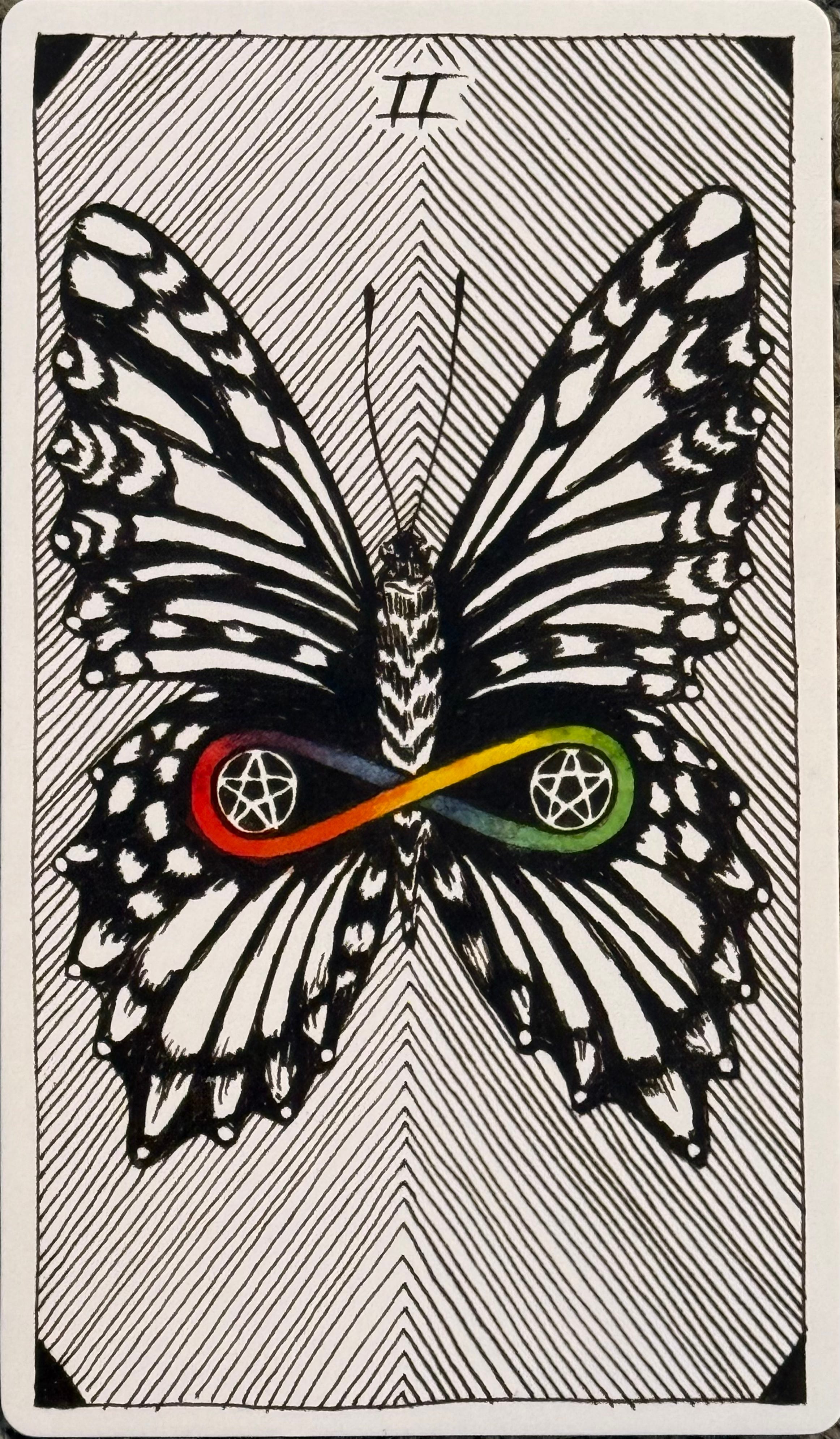
“The Two of Pentacles signifies inevitable change. Since the pentacle suit relates to earthly possessions, this usually means a new job, financial situation, or move. Even if you fear this change, it needs to happen, and might even be fun. Face it with the grace of a newly formed butterfly, a world of possibilities balanced upon your delicate wings.”
That’s not a prophecy.
It’s a mirror.
Change, instability, balancing competing demands, fear mixed with possibility. Those are universal human experiences. The image doesn’t cause them. It gives your psyche a way to recognize them.
Tarot helps people articulate what they already feel but haven’t named.
Now, spirituality absolutely can be involved in tarot.
I’ve said before, psychology and spirituality are using two different sets of tools to investigate reality. Mystery. Meaning. Identity. Transformation.
Many people experience tarot spiritually. They pray. They meditate. They experience insight, connection, and sometimes even reverence through the practice. That shouldn’t be dismissed or mocked.
But spirituality isn’t required for tarot to be meaningful.
Tarot speaks the native language of the human brain. Symbol. Image. Story. Metaphor. That’s why it works whether someone frames it psychologically, spiritually, or somewhere in between.
Studying the neurological and psychological mechanisms at play doesn’t strip tarot of meaning any more than studying the brain strips love of meaning.
It tells us how humans encounter depth.
Here’s the part that tends to make fundamentalists uncomfortable.
Christianity already relies on the exact same mechanism.
Jesus didn’t teach with bullet points or systematic theology. He taught with parables. Seeds. Soil. Light. Darkness. Wilderness. Death and rebirth. The Bible is saturated with archetypal imagery. Exodus. Exile. Flood. Fire. Breath. Spirit. When Christianity is flattened into literalism, it doesn’t become more faithful.
It becomes less human.
Tarot isn’t in opposition to Christianity. It’s operating in the same symbolic terrain Christianity has always depended on. And if you’d like to read Christian meditations on tarot, Meditations on the Tarot: A Journey into Christian Hermeticismis an excellent book.
Tarot helps people tell the truth about the present.
Whether you’re an atheist or a Christian, learning to engage imagery and archetype can make you more self-aware, more honest, and less trapped in fear-based certainty. And if your faith collapses the moment it encounters a deck of cards, the problem probably wasn’t tarot.
It was a version of faith that confused certainty with trust and control with truth.


